Passive radiative cooling, the cement that sends heat back into space
The key to cooling our cities does not lie in inventing new materials, but in redesigning the cement we already use.
During the warmest months, large cities turn into authentic thermal batteries capable of absorbing sunlight all day long and storing that energy within their structures. At nightfall, when temperatures should offer a reprieve, these infrastructures release the accumulated energy into the surrounding air. And it is precisely this process that prevents the environment from cooling down at night, feeding the phenomenon known as the Urban Heat Island.
The problem is significant, since the built mass alters the local microclimate, drives up the need for air conditioning, and worsens health risks. At the center of this problem lies traditional concrete, the world’s most consumed material and the great sponge absorbing heat within our cities.
Facing this reality, our photonic technology proposes a radical shift, turning buildings and cities into tools to actively expel temperature instead of allowing them to act as ovens.
The physics of cold in the atmospheric window
The solution lies in photonic materials engineering. Photokrete’s research aims to modify how cementitious materials interact with solar radiation, without altering their strength or structural properties in the least.
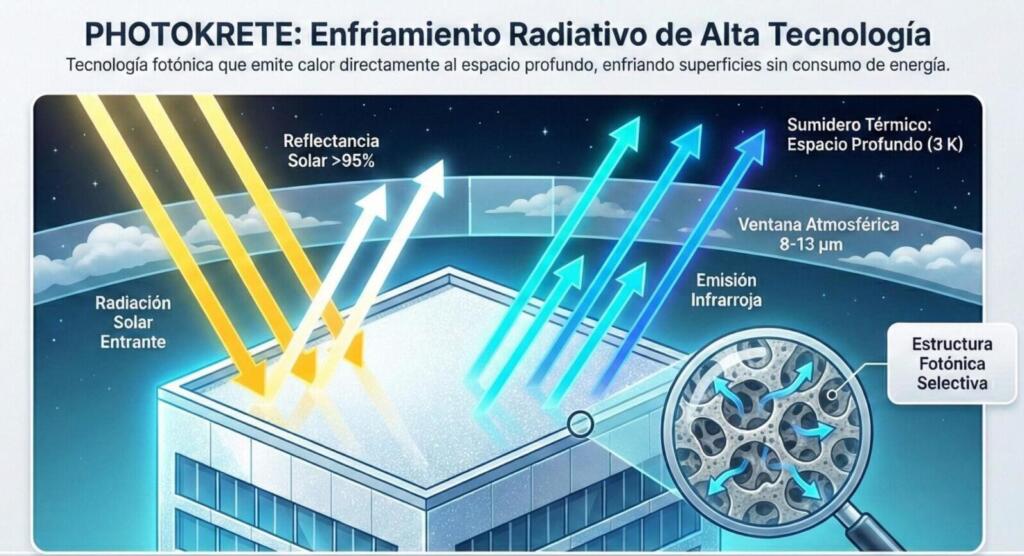
Unlike traditional solutions—which return heat to the street-level air—our photonic materials use passive radiative cooling. This mechanism leverages a physical principle known as the atmospheric transparency window: a very specific band of the infrared spectrum (between 8 and 13 microns) through which the Earth’s atmospheric gases do not absorb energy.
Thanks to the photonic technology we apply, the cement re-emits precisely at that wavelength. Thus, the heat does not remain in the lower layers of the atmosphere nor does it warm the streets; the energy completely crosses the atmosphere and directly dissipates into cold outer space. This achieves net cooling without consuming energy or warming the city air.
Applied in pavements, facades, and roofs
The technology developed by Photokrete integrates naturally into the three key elements of any building or city:
- Pavements and roadways: Replacing traditional ground surfaces with photonic options prevents streets and sidewalks from overheating, reducing the heat reaching us directly at street level.
- Vertical facades: Applying it to exterior walls decreases the heat absorbed by buildings, lowering the need to turn on indoor air conditioning.
- Roofs and rooftops: On top surfaces—those hit hardest by continuous sunlight—the material acts as a shield that expels temperature without spending a single drop of water or a watt of electricity.
A global impact solution
The great value of this technology lies in its easy scalability. The new photonic concrete adapts seamlessly to current production and construction processes, facilitating mass adoption.
Intervening in construction’s cementitious materials to expel heat outside the planet constitutes the most powerful, rapid, and direct tool for adapting cities to climate change.